
Founding Charter
The Constitution of Olevus
The founding charter of a sovereign social ecosystem.
Ratified at founding · The Founders of Olevus
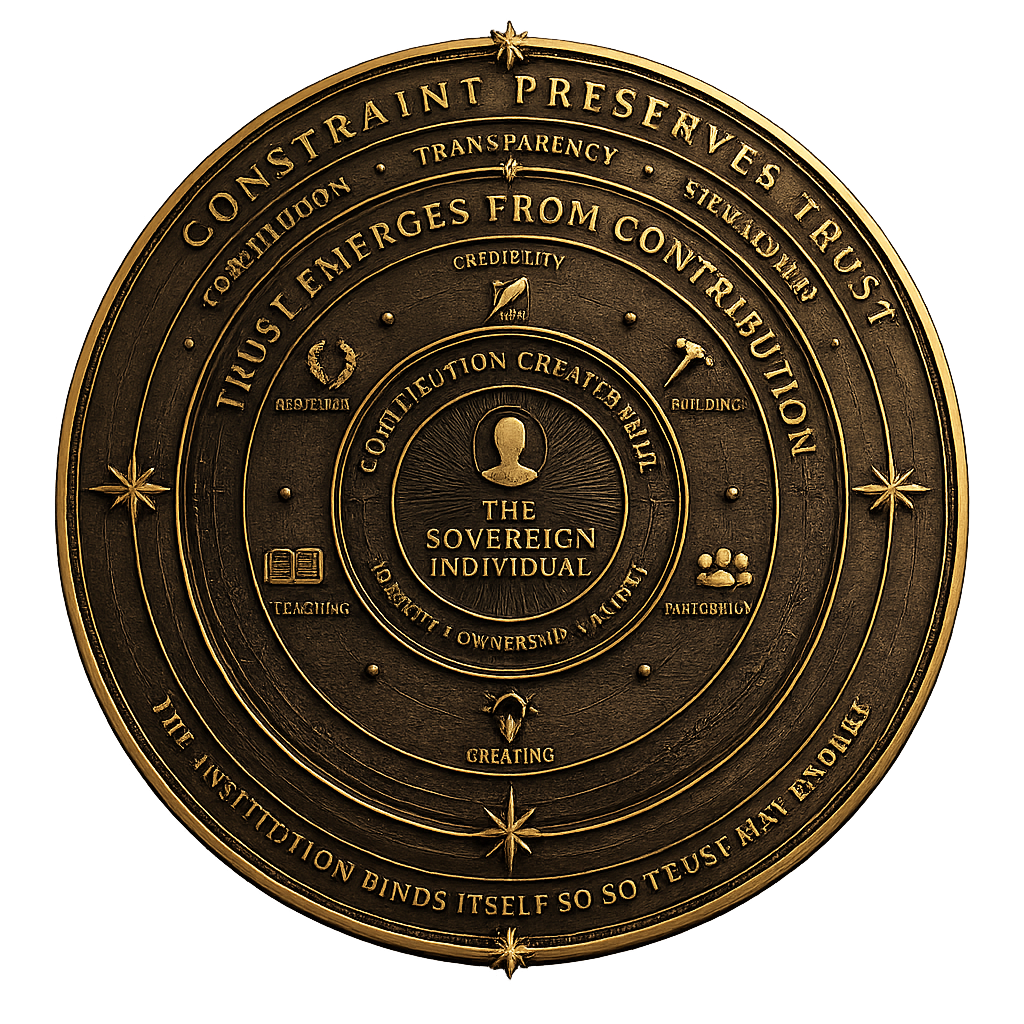
We, the founders of Olevus, establish this Constitution to set the terms of a social ecosystem in which the individual is sovereign, contribution creates value, and trust is built under constraint. This document is the charter of the institution. It binds us before it binds anyone else.
An authority that voluntarily binds itself produces the only trust worth holding.
Article I
Membership and the Sovereign Individual
Every member of Olevus is recognized as a sovereign individual: the sole author of their identity, the sole owner of their contributions, and the sole custodian of their standing within the ecosystem.
Membership is granted by choice and held by good faith. No member may be silently demoted, shadow-restricted, or quietly removed. Any consequence affecting a member's standing must be visible, reasoned, and appealable.
Article II
Contribution as the Source of Value
Value within Olevus originates in contribution — the writing, the building, the gathering, the support given to others. The platform does not generate standing; it records it.
Recognition shall be tied to observable contribution and shall not be purchasable, transferable, or assignable by administrative discretion.
Article III
Trust Requires Constraint
Trust is the most valuable currency Olevus issues. To preserve it, the institution accepts binding constraint upon itself: published rules, public reasoning, and a written record of every meaningful change to the standard.
An institution that may break its own rules at will has no rules. Olevus chooses to be constrained.
Article IV
Ownership of Work, Identity, and Audience
What a member creates on Olevus belongs to that member. The audience a member cultivates belongs to that member. The reputation a member earns belongs to that member.
Olevus shall provide durable mechanisms for export, portability, and continuity of identity, such that no member is ever held hostage to remain.
Article V
Due Process and the Right to Reasoned Decision
Any moderation action shall produce, at minimum: the rule applied, the conduct observed, the decision reached, and a path for appeal. Silent enforcement is contrary to this Constitution.
No member shall lose standing without notice. No member shall be removed without record.
Article VI
Amendment and Public Record
This Constitution may be amended only in the open. Every revision shall be recorded in a public log, dated, and accompanied by the reasoning behind it.
The institution accepts that the cost of changing the standard in public is the discipline that preserves the standard at all.
“An institution that may break its own rules at will has no rules.”
— The Constitution of Olevus
The constitution is signed not by founders but by every member who chooses to be bound by it.