
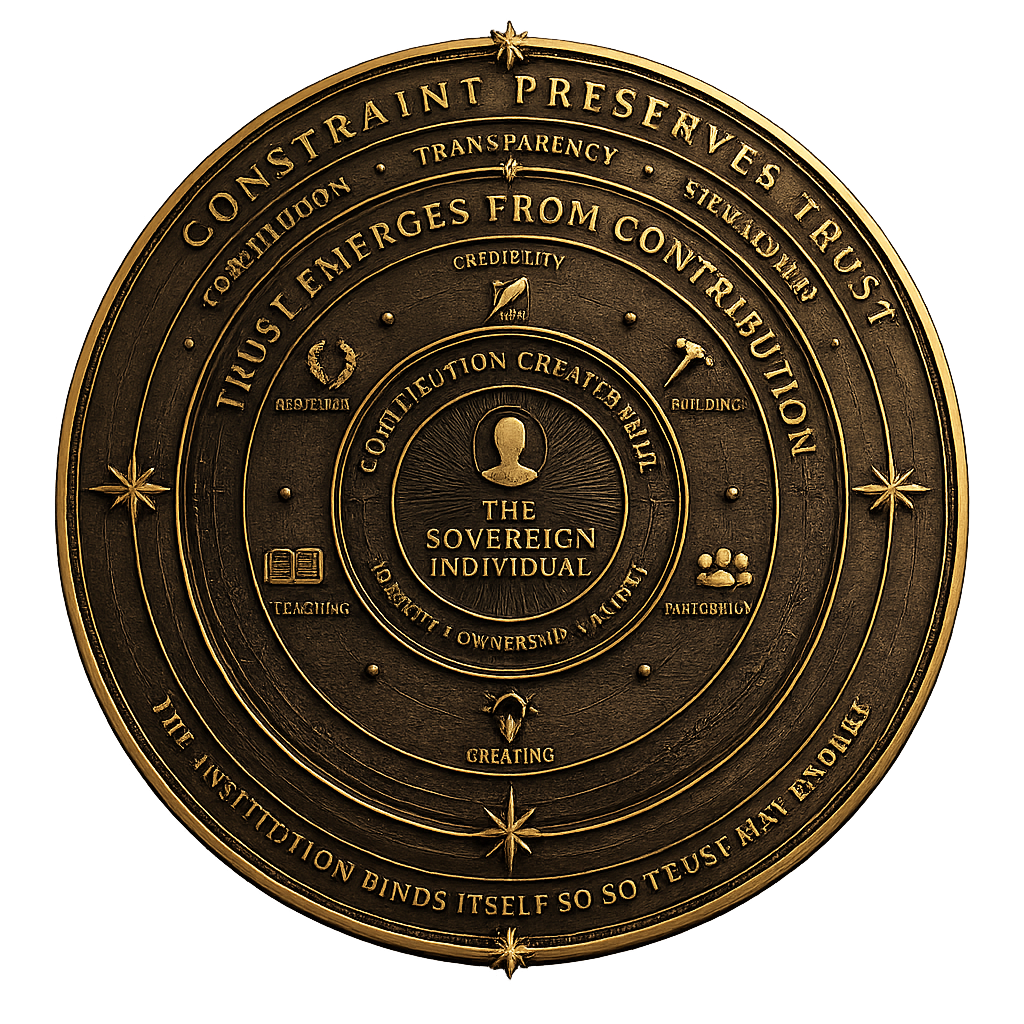
Founding Charter · Record I
Constitution of Olevus
A Sovereign Social Ecosystem
The Founders of Olevus
Olevus is founded upon the belief that individuals possess the capacity to think, create, contribute, associate, and govern themselves responsibly within a framework of shared principles. This Constitution exists to preserve the conditions under which identity, contribution, reputation, trust, and community may flourish. It establishes the principles by which Olevus operates, the rights and responsibilities of its members, and the limitations placed upon platform authority. Its purpose is not to eliminate disagreement, but to provide a durable framework through which individuals may participate, contribute, build, and exchange ideas through constitutional participation.
Before trust could be given, it first had to be earned.
Article I
Foundational Principles
Olevus is guided by the following principles:
- Identity matters.
- Contribution matters.
- Reputation is earned.
- Trust must be built.
- Authority must remain accountable.
The preferred solution to lawful disagreement is choice, not control.
Governance should be based upon conduct, evidence, and constitutional standards rather than subjective disagreement with ideas, beliefs, opinions, or viewpoints.
Article II
Membership
All members possess equal constitutional protections under this Constitution.
Members possess the right to constitutional participation, open discourse, voluntary association, ownership of their original contributions, procedural fairness, and the opportunity to build reputation through participation.
Constitutional participation consists of participation consistent with the rights, responsibilities, and principles established by this Constitution.
Members likewise bear responsibility for conducting themselves honestly, respecting the rights of others, maintaining the integrity of the platform, and participating in good faith.
Olevus distinguishes between expression, conduct, and fraud.
Expression shall receive the broadest constitutional protection.
Conduct may be governed according to constitutional standards.
Fraud consists of intentional material deception, impersonation, or misrepresentation undertaken for gain, advantage, or other improper benefit.
Fraud receives no constitutional protection merely because it is communicated through speech.
Article III
Identity, Contribution & Reputation
Identity serves as the foundation upon which participation, contribution, reputation, and trust are built.
Members retain ownership of their original intellectual contributions, subject to the platform's published terms governing hosting, distribution, and operation of the service.
Members possess the right to reasonable attribution for their original work.
Reasonable attribution includes acknowledgment of original authorship when original contributions are reproduced or substantially summarized within the platform.
Reputation is not assigned by Olevus.
It emerges through the cumulative judgments of participants over time.
The purpose of the platform is not to determine reputation, but to provide an environment in which reputation may be earned.
Contribution serves as the primary foundation of reputation.
The Constitution recognizes that reputation may be strengthened, diminished, restored, or redefined through future participation and conduct.
Article V
Communities & Association
Members possess the right to form, join, leave, and organize lawful communities consistent with this Constitution.
Communities may establish their own cultures, standards, and participation expectations, provided they remain consistent with constitutional principles.
Participation in communities is voluntary.
Communities may recognize contribution and achievement but may not create constitutional classes of membership.
The platform shall favor freedom of association, voluntary separation, and the creation of alternatives over centralized intervention.
Article VI
Technology & Stewardship
Technology exists to support human participation.
Artificial intelligence and automated systems may assist the operation of the platform but possess no independent constitutional authority.
AI may assist, analyze, inform, recommend, and detect.
AI may not define constitutional participation, expand its own authority, or exercise governance independently.
Human review shall remain meaningful and shall not exist solely to ratify automated recommendations.
Leadership serves as steward of the platform and this Constitution.
The Constitution may evolve through deliberate processes established by leadership and informed by meaningful member review and participation.
Foundational principles should not be altered lightly or in response to temporary pressures.
Article VII
Founding Registry
The Founding Registry serves as the historical record of those who established their place within Olevus during its formative period.
Founding status recognizes historical participation rather than constitutional superiority.
All members remain equal under this Constitution regardless of founding status, reputation, influence, or prominence.
The Registry exists to preserve institutional memory and continuity between the platform's origins and its future.
Closing Charter
Olevus does not promise agreement.
It does not promise popularity.
It does not promise protection from criticism, disagreement, error, or the consequences of one's own actions.
Instead, it seeks to provide a framework within which individuals may participate, contribute, build reputation, establish communities, exchange ideas, and pursue opportunity through constitutional participation.
This Constitution favors freedom over control, transparency over secrecy, accountability over arbitrariness, and persuasion over coercion.
It recognizes that trust is earned, reputation is built, and authority remains worthy of confidence only when it is constrained.